 Infotel, là où vous êtes
The Future of Intelligent Document Management
The Future of Intelligent
Document Management
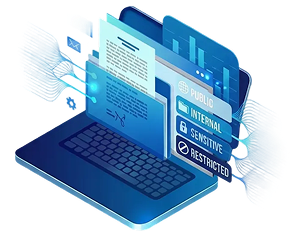
Building Enterprise-Grade AI Assistants: The Future of Intelligent Document Management
Enterprise AI has gone through a huge shift. Organisations worldwide are witnessing the emergence of sophisticated AI systems that understand and process vast amounts of information and provide contextually relevant, secure, and role-based responses to complex business queries.
Enterprises generate and manage enormous volumes of documents across multiple departments, from legal contracts and financial reports to technical specifications and compliance documentation. Traditional document management systems often fall short of providing intelligent, contextual access to this information, creating bottlenecks that hinder productivity and decision-making processes.

The Rise of Retrieval-Augmented Generation in Enterprise
Retrieval-Augmented Generation (RAG) changes the way organisations handle information and find knowledge. Instead of using only information they were trained on, RAG systems look at and use an organisation’s current information. This makes sure the answers they give are both correct and up to date.
RAG systems’ fundamental advantage lies in their ability to combine the generative capabilities of large language models with real-time access to enterprise-specific knowledge bases. This creates a powerful synergy, allowing AI assistants to provide precise, contextually relevant answers while maintaining strict security and access controls
This approach provides significant business value. Organisations using RAG have seen time savings of 15-20% because they use their knowledge more effectively. They also cut costs by automating the process of finding information. This technology successfully tackles major corporate difficulties, such as when knowledge is kept in isolated groups, when sharing information is slow, and when dealing with complex regulatory rules.
Architectural Excellence: Building Reliable AI Systems
The foundation of any successful enterprise AI assistant lies in its architecture. Modern RAG systems require sophisticated coordination of multiple components, each designed to handle specific aspects of the information processing pipeline.
Document Ingesting and Processing
The journey begins with intelligently reading documents from many sources, including cloud storage, internal databases, and live data feeds. Advanced systems automatically sort documents, pull out key descriptive information (metadata), and prepare the content. This step makes certain the information is structured correctly and easy to access.
Breaking documents into smaller pieces (chunking) is vital for keeping the document’s flow while still allowing for very accurate information retrieval. Organisations are now using methods that keep the document’s structure in mind, like sections and paragraphs. They are moving away from simply splitting text based on character counts.
The core of RAG: Vector Databases
RAG systems are built around advanced vector databases. These databases hold numerical representations of documents (embeddings) along with rich information about them (metadata).
Many modern companies use databases like ChromaDB because it handles complex filtering of this metadata. This allows for precise control over who can access what and helps keep different groups’ data separate.
These systems use advanced methods to organise data (indexing) to be fast to search while not taking up too much space. They often use overlapping data sections and duplicate data in specific ways to boost both security and speed. The metadata is the basis for setting up permission levels, which guarantee users only find documents that match their specific company access rights.
Agentic Workflow Coordination
Modern AI assistants use agentic designs that allow for advanced decision-making and task coordination. These systems use tools like LangGraph to build workflows that are dynamic and can remember context. This lets them adapt based on what the user wants and needs.
The agentic method helps AI assistants break down hard questions into smaller steps. They can coordinate multiple information sources and recall what was said during lengthy conversations. This leads to responses that are more natural and helpful for business needs.
Security and Access Control: Protecting Business Knowledge
Business AI assistants must have strong security to protect sensitive information while keeping the system easy to use. Role-based access control (RBAC) is the most important part of business security. It manages detailed permissions that match the company’s structure and job responsibilities.

Multi-Layered Security Architecture
Current systems use a deep defense strategy to protect data at many levels. This includes:
- Encryption (scrambling data) for documents and their embeddings when they are stored and when they are being moved.
- Secure communication rules.
- Complete tracking (audit logging) for compliance rules.
Advanced systems use exact access control that works down to the document, section, or even paragraph level. This helps keep sensitive details protected while the system still works for users who are allowed to use it.
Department-Based Filtering
Setting up document access based on departments creates clear security boundaries that fit the company’s organisation. This method lets users only see documents that matter to their jobs, which lowers the chance of information leaks and makes searches more accurate.
Conversational Memory and Context Management
Business AI assistants require sophisticated systems to manage memory, allowing them to have clear, relevant conversations across multiple interactions. Current systems use PostgreSQL-based checkpointing to save conversation progress. This keeps the chat state permanent and allows the system to easily handle many concurrent users.
Thread-Level Persistence
Advanced memory designs save the chat context at the session level. This maintains conversation relevance while keeping different users’ data separate. This lets the AI assistant refer back to previous chats, stay aware of the context, and provide increasingly personalised replies as the interaction continues.
Conversation State Management
Sophisticated systems track the user’s goal, the flow of the conversation, and other background information during multi-step chats. This lets the AI assistant maintain coherent conversations, remember user preferences, and provide more effective assistance as the interaction develops.
Implementation Excellence: From Backend to Frontend
Setting up business AI assistants requires careful coordination of backend processing and user-friendly interfaces. Current systems use FastAPI for high-performance backend services. This lets them handle simultaneous requests while maintaining response quality and system reliability.
API Architecture and Performance
Asynchronous API set-ups guarantee optimal performance under heavy use and keep the system responsive. Advanced caching, connection pooling, and request optimisation techniques allow the systems to handle enterprise-scale usage without slowing down.
Frontend Integration
Modern AI assistants have advanced user interfaces built with current frameworks that provide intuitive user experiences. These interfaces support real-time messaging, file uploads, chat history, and advanced search features that make complex AI systems accessible to non-technical users.
Business Impact and Return on Investment
Implementing smart AI assistants provides clear business value in many areas. Organisations report major improvements in productivity, the speed of decision-making, and how easily staff can access knowledge. This directly impacts the company’s financial results.
Operational Efficiency Gains
Business AI assistants typically lead to 30–50% faster information retrieval. This allows employees to focus on higher-value activities. Automating common questions and information gathering creates substantial productivity increases across the entire organisation.
Knowledge Management Revolution
AI assistants transform how a business handles its knowledge by making company information accessible, searchable, and usable. This reduces reliance on specific experts, improves staff induction, and makes certain critical information remains available even when employees change roles.
Compliance and Risk Management
Advanced AI systems assist with following compliance rules by applying policies and procedures consistently across the company. Automated audit logs, access tracking, and content verification capabilities reduce compliance risks while improving the accuracy of regulatory reporting.
Future-Proofing Business AI Investments
The speed at which AI technology changes means business systems must be able to adapt and grow. Modern RAG set-ups are built to be modular and extensible. This allows organisations to add new capabilities without having to restructure the entire system.
Scalability and Performance
Business-grade systems use horizontal scaling architectures that can handle increasing amounts of data and more users. Advanced load balancing, distributed processing, and clever caching provide consistent performance as the organisation’s needs expand.
Integration Capabilities
Contemporary AI assistants offer comprehensive integration capabilities that connect with existing business systems, including CRM platforms, document management systems, and business intelligence tools. This makes certain AI features enhance rather than replace existing workflows.
The Competitive Advantage of Custom AI Solutions
While basic, ready-made AI tools are available, custom-built AI assistants provide a competitive advantage that precisely matches the organisation’s needs and goals. These systems offer better security, performance, and functionality compared to generic options.
Tailored Intelligence
Custom AI assistants understand the organisation’s specific language, processes, and requirements in a way that generic systems cannot. This results in more accurate replies, better user experiences, and higher adoption rates throughout the organisation.